


Beyond Gender Roles
- March 10, 2026
- Posted by: CIF Admin
- Category: Blog
Just like the best commentary on the Bhagavad Gita is the Gita itself, the best way to understand Swami Chinmayananda’s outlook towards women is to look at his actions and words. Swami Chinmayananda’s contribution to women empowerment lies in how he re‑framed womanhood as a spiritual identity rather than a catalogue of gender‑based duties.
In a letter from 1966, Swami Chinmayananda writes to a female devotee “Be just yourself. You are neither a wife, nor a mother, nor an artist, nor a woman, not even a devotee; you are just His creature in the presence of the Holy Creator. Let the peace of the evening envelope and swallow you up. Let the music of the setting sun joyously pervade your within. Let the beams of effulgent fragrance, sweet in the taste of its colors, embrace to whisper you the Supreme Self who functions behind all sense-organs.”
Swami Chinmayananda, a proponent of following swami-dharma, asked women to introspect and follow their dharma. To a doctor who was also a wife he wrote, “Your problem is a typical example of fundamental mistake multiplying into a chain of mistakes. The ‘Dr.’ in you should not have married: the ‘wife’ in you should not have been a doctor! The duties of a ‘wife’ must necessarily collide into the duties of the ‘Dr.’ something like the married Mahatma!!
“Now you must decide: are you essentially the wife and Mother —or merely the Doctor? Accept the important role as your duty and the other as an added chance for ‘Seva’ as a wife who is also a good songster! Wife-hood the essential duty, to the music in her an added charm in her domestic life!
“Similarly— I feel that you are essentially the wife and the Mother. Your M.D. and the experiences are no doubt your added charm. “Practice medicine and serve the society wherever your husband is. Serve him and your son —–I feel these are the main duties of the wife and the mother in you. The Dr. must play the 3rd place to the main part, the mother to the 2nd and then wife. This is for the ordinary woman. If you feel that the Dr. in you had married-and begot the child and so Dr. is the main: wife and motherhood secondary, then what you are now doing is right. But the real ‘Dharmo-meter’ is your own ‘person’. Are you happy-undisturbed by the regrets-pangs?”
This practical sensitivity is undergirded by a deeper, radically non‑dual intuition. Where many gurus idealised women as mothers or devotees, Swami Chinmayananda invited them to be teachers, leaders, and even sannyasinis. From the early 50’s, Swaminis like Saradapriyananda and others have taken on prominent roles in Vedanta teaching, rural‑reform and mission‑building that were often in contemporary organisations tightly reserved for men. Currently close to 41% of Chinmaya Mission Swamins (spiritual teachers) are women.
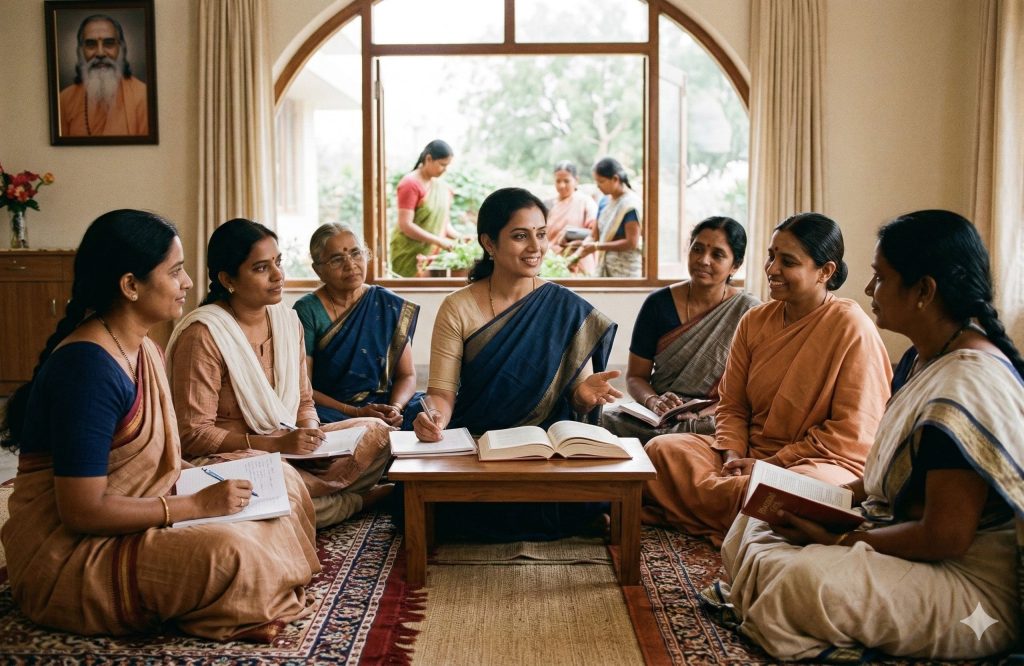
At the broader institutional level, he formally honoured mothers as the bearers of spiritual culture. At the inauguration of the first Devi Group in Chennai, in 1958, he said, “Salutations to Mothers! I need not mention how happy I am that a Devi section of Chinmaya Mission is being inaugurated on this sacred day. Indeed, women have been, and even today are, the real custodians of our country’s spiritual culture. The fall of our cultural standard is a true measure of the growing ignorance in the mothers of our society.” This is not a sentiment, but a public declaration of spiritual authority resting with women, and it is reinforced by the structure of Devi Groups, women‑only satsangs.
Taking this vision forward is CORD, Chinmaya Organisation for Rural Development, operating in Himachal Pradesh, Tamil Nadu, Sri Lanka and USA. It is rooted in the belief that people, especially women, are active partners in development, and not just recipients of aid. This women empowerment-based approach over a project-based approach, makes CORD uniquely successful and socially impactful.
Thus, in contrast with many traditional lineages that kept women largely in the background, Swami Chinmayananda’s vision was that women be anchors of dharma inside the family and leaders of dharma outside it, equally at home in scriptural study, sannyasa, and organised service. His contribution to women empowerment is a triple‑pronged legacy: a non‑dual self‑understanding, a gender‑inclusive teaching–leadership culture, and an institutional architecture that entrusts women with the transmission of spiritual and social values.
Hari Om!
Cauvery Bhalla
Leave a Reply Cancel reply
You must be logged in to post a comment.
