


- Description
- Curriculum
- Reviews
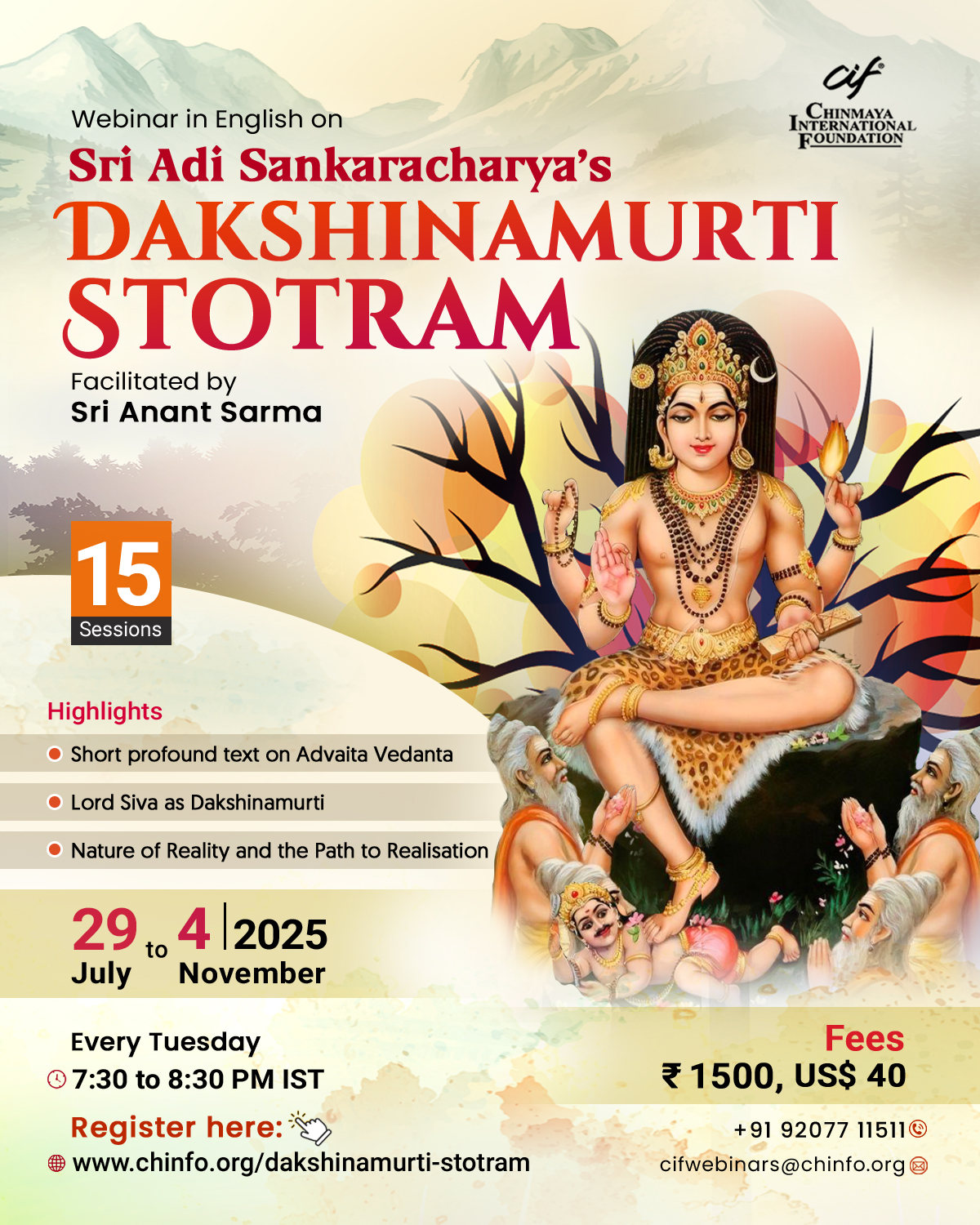
Dakshinamurti Stotra, composed by Bhagavan Shankaracharya, is a concise yet deeply insightful hymn that explores the principles of Advaita Vedanta.
Dakshinamurti, a manifestation of Lord Shiva, represents the embodiment of pure knowledge and is revered as the supreme teacher of Brahma Vidya, who removes the ignorance of seekers through true wisdom. While Lord Shiva is traditionally associated with relative (apekshika) destruction, where, during pralaya, the universe dissolves, ignorance (ajnana) still endures. The complete and final destruction of this ignorance, especially the dissolution of duality (dvaita), known as atyantika-nasha, is accomplished by Lord Shiva in His form as ‘Dakshinamurti’.
Dakshinamurti Stotra expounds the non-dual nature of reality and the essential unity of Brahman – the ultimate reality – with the individual self, the Atman. Although structured as a stuti, or a hymn of praise, Sri Adi Sankaracharya skillfully weaves the entire vision of Vedanta into these verses, glorifying Brahma Vidya and underscoring the vital role of the Guru in leading seekers toward Self-realisation.
Dakshinamurti Stotra delves deeply into the essence of Vedanta, and for this reason, it is regarded not merely as a devotional hymn (stotra grantha), but as a prakarana grantha, a foundational Vedantic text. One of Sri Sankaracarya’s direct disciples, Suresvaracarya, composed a detailed vartika (elaborate commentary) on this stotra. This vartika, titled Manasollasa, consists of approximately 144 verses, offering an in-depth exposition of a text that originally contains just eight verses – highlighting its profound depth and significance.
Further enriching this tradition, a scholar named Svayamprakashayati wrote a commentary on Manasollasa, and Sri Rama Tirtha contributed commentaries on both the Manasollasa and the Dakshinamurti Stotra itself. Traditionally, the Dakshinamurti Stotra is chanted before studying Sankara’s commentaries (bhashyas) on texts such as the Brahma Sutra, Bhagavad Gita or the Upanishads.
In essence, the Daksinamurti Stotra serves as a powerful aid for spiritual seekers, illuminating the nature of reality and the path to realization under the guidance of the ultimate Guru–Lord Siva himself.
Webinar Highlights
- Short but profound text of 8 verses that delves into Advaita Vedanta philosophy
- Essence of the Upanishads is elegantly presented through Lord Siva as the Guru
- Offers insights into the nature of reality and the path to realization
Webinar Format
- Weekly once online session
- The sessions will be streamed on Zoom. Those who miss the online session can listen to the recordings available in the dashboard.
Webinar Details
Dates: 29 July to 4 November 2025
Timings: 7:30 – 8:30 PM IST (10:00 – 11:00 AM EST, US)
Frequency: Everyday Tuesday
Fees: Rs. 1500; US$40
Prerequisite
- Availability of a computer with audio -video internet conferencing facility.
- Prior study of Bhagavad Gītā and a few upaniṣad-s is helpful.
- Access to Zoom
Referral Book
Hymn to Dakshinamurti By Adi Shankaracarya Commentary by Swami Chinmayananda
About the Facilitator
Sri Anant Sarma has been associated with Chinmaya Mission for more than four decades. An engineer from IIT Madras, he went to the USA for further studies. His work experience covers both academia and industry in engineering and finance administration.
Know more about Sri Anant Sarma.
Contact Details
For further information or clarification
Phone: +91 92077 11511
Email: cifwebinars@chinfo.org
-
1
 Dakshinamurti Dhyana Sloka-s and Stotra-s
 -
2
 Session 01 - Introduction
 -
3
Session 01 - Introduction (Audio)
-
4
Session 01 - Introduction (Note)
-
5
Session 02 - Dakshinamurti Stotra Dhyana Sloka 1
-
6
Session 02 - Dakshinamurti Stotra Dhyana Sloka 1 (Audio)
-
7
Session 02 - Dakshinamurti Stotra Dhyana Sloka 1 (Note)
-
8
Session 03 - Dakshinamurti Stotra Dhyana Slokas 1 (contd.) - 3
-
9
Session 03 - Dakshinamurti Stotra Dhyana Slokas 1 (contd.) - 3 (Audio)
-
10
Session 03 - Dakshinamurti Stotra Dhyana Slokas 1 (contd.) - 3 (Note)
-
11
Session 04 - Dakshinamurti Stotra Dhyana Sloka 4 - 6
-
12
Session 04 - Dakshinamurti Stotra Dhyana Sloka 4 - 6 (Audio)
-
13
Session 04 - Dakshinamurti Stotra Dhyana Sloka 4 - 6 (Note)
-
14
Session 05 - Dakshinamurti Stotra Sloka 1
-
15
Session 05 - Dakshinamurti Stotra Sloka 1 (Audio)
-
16
Session 05 - Dakshinamurti Stotra Sloka 1 (Note)
-
17
Session 06 - Dakshinamurti Stotra Sloka 1 (contd.)
-
18
Session 06 - Dakshinamurti Stotra Sloka 1 (contd.) (Audio)
-
19
Session 06 - Dakshinamurti Stotra Sloka 1 (contd.) (Note)
-
20
Session 07 - Dakshinamurti Stotra Sloka 2
-
21
Session 07 - Dakshinamurti Stotra Sloka 2 (Audio)
-
22
Session 07 - Dakshinamurti Stotra Sloka 2 (Note)
-
23
Session 08 - Dakshinamurti Stotra Sloka 2 (contd.)
-
24
Session 08 - Dakshinamurti Stotra Sloka 2 (contd.) (Audio)
-
25
Session 08 - Dakshinamurti Stotra Sloka 2 (contd.) (Note)
-
26
Session 09 - Dakshinamurti Stotra Sloka 3
-
27
Session 09 - Dakshinamurti Stotra Sloka 3 (Audio)
-
28
Session 09 - Dakshinamurti Stotra Sloka 3 (Note)
-
29
Session 10 - Dakshinamurti Stotra Sloka 3 (contd.)
-
30
Session 10 - Dakshinamurti Stotra Sloka 3 (contd.) (Audio)
-
31
Session 10 - Dakshinamurti Stotra Sloka 3 (contd.) (Note)
-
32
Session 11 - Dakshinamurti Stotra Sloka 4
-
33
Session 11 - Dakshinamurti Stotra Sloka 4 (Audio)
-
34
Session 11 - Dakshinamurti Stotra Sloka 4 (Note)
-
35
Session 12 - Dakshinamurti Stotra Sloka 5
-
36
Session 12 - Dakshinamurti Stotra Sloka 5 (Audio)
-
37
Session 12 - Dakshinamurti Stotra Sloka 5 (Note)
-
38
Session 13 - Dakshinamurti Stotra Sloka 6
-
39
Session 13 - Dakshinamurti Stotra Sloka 6 (Audio)
-
40
Session 13 - Dakshinamurti Stotra Sloka 6 (Note)
-
41
Session 14- Dakshinamurti Stotra Sloka 7
-
42
Session 14- Dakshinamurti Stotra Sloka 7 (Audio)
-
43
Session 14- Dakshinamurti Stotra Sloka 7 (Note)
-
44
Session 15 - Dakshinamurti Stotra Slokas 8-10
-
45
Session 15 - Dakshinamurti Stotra Slokas 8-10 (Audio)
-
46
Session 15 - Dakshinamurti Stotra Slokas 8-10 (Note)
Inclusive of 18% GST


