


- Description
- Curriculum
- Reviews

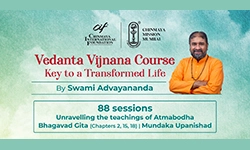
Vedanta Vijnana – Key to a Transformed Life is a Course, jointly conducted by Tara Cultural Trust, Chinmaya Mission Mumbai and Chinmaya International Foundation, is designed by Swami Advayananda, the Resident Acharya of the Sandeepany Vedanta Course, to enable both a novice and a sincere seeker study deeply the essentials of Vedanta to live a transformed and evolved life. The Course will span 88 Sundays with one-hour sessions.
‘Vedanta’ is the comprehensive Science of Reality dealing with the knowledge of the Self and enabling a transformed life. ‘Vijnana’ is deep and clear knowledge. This Course aims to present the essentials of Vedanta through the study of select treatises of Vedanta that throw light on its salient aspects. This Course is not just for an intellectual study but rather for one to apply the Vedantic teachings in one’s life for a transformative experiential knowledge. Gurudev Swami Chinmayananda would often exhort: Understand and then stand under! The texts for the Vedanta Vijnana Course are chosen with this intention.
Atmabodha will be the first text that will be studied. It provides the student clarity on the essential concepts of Vedanta and the terms used. It provides an ideal foundation for the Vedanta Vijnana Course.
The Bhagavad Gita is unmatched and unparalleled in its presentation of the entire knowledge of Vedanta. It is a teaching of Lord Sri Krishna to the earnest Arjuna who sought solutions to life’s challenges in the workaday world. It thus provides valuable insights and teaches the application of Vedanta in daily life. Arjuna truly represents each one of us seeking to break our barriers and unfold into a transformed being of wisdom and efficiency. Thus the teaching of the Lord will be the highlight of the Vedanta Vijnana Course. Few select Chapters of the Bhagavad Gita have been carefully chosen for this Course.
The Bhagavad Gita Chapter 2 is the summary of the entire Bhagavad Gita in prospect while Chapter 18 is the summary in retrospect. And Chapter 15 is a succinct summary of the entire philosophy of Vedanta. These three Chapters form the core of the Vedanta Vijnana Course.
Upanishads form the very foundation of the philosophical system of Vedanta. No study of Vedanta would be complete without delving into their mysterious depths. They are the highest and most sublime expressions that voice the wisdom of the Rishis. And of all the Upanishads, the Mundakopanishad of the Atharva Veda is exemplary in providing the complete overview of Vedanta.
Thus, these texts form the syllabus of the Vedanta Vijnana Course and are ideal for equipping us with the wisdom to live a life of true meaning, purpose, and fulfilment.
The Vedanta Vijnana Course will be conducted in hybrid mode – On-site at Sandeepany Sadhanalaya, Powai, Mumbai and Online via Zoom.
The Sandeepany Sadhanalaya is the Gurukula of the Chinmaya Mission and the first Ashram of the Chinmaya Mission established by Pujya Gurudev Swami Chinmayananda. Those who join on-site for the Vedanta Vijnana Course will be truly blessed to bask in the aura of this divine Gurukula and study these priceless treatises enshrining the highest wisdom.
More about the Vedanta Vijnana Course
Atmabodha (approx. 18 sessions)
Atmabodha is a prakarana-grantha authored by Sri Adi Sankaracharya and is an essential treatise to gain Vedantic concept clarity. The unique aspect of this text is that it provides complete clarity on all important Vedantic concepts through suitable examples, similes and metaphors thus enabling easy comprehension.
Bhagavad-gita Introduction, Dhyana Shlokas and Chapter 2 (approx. 21 sessions)
The second chapter, ‘Sankhya Yoga’, is said to contain the essential teachings of the Bhagavad-gita. After silently witnessing Arjuna’s deluded outpour, the Lord lashes out and admonishes him that such behaviour does not befit him. The real teaching begins when Arjuna finally surrenders to the Lord as His disciple and requests for guidance.
In this entire chapter, the Lord has mainly glorified Sankhya Yoga – ‘Atmavidya’, briefly touching upon Karma Yoga and Bhakti Yoga, which are elaborated upon in later chapters. The Lord not only prods Arjuna to follow his svadharma (duty) but also explains the reasons for doing so. The Chapter also elaborates upon the ‘Man of Perfection’ through the Sthitaprajna Lakshana section at the end.
Bhagavad-gita Chapter 15 (approx. 6 sessions)
The fifteenth chapter of Gita ‘Purushottama Yoga’, mystically describes the nature of the world with the metaphor of an upside-down Ashvattha tree, which can be axed by steady and firm non-attachment. Having thus laid the foundation, the Lord next enumerates the nature of the individual soul or jiva. Continuing the thread of thought, the nature of God or Ishvara is expounded upon. Having unravelled each individual constituent, the Lord goes on to tie all ends together by explaining the relationship between the three. The fifteenth chapter systematically explains some of the simple yet profound questions that philosophy seeks to answer.
Mundaka-upanishad (approx. 17 sessions)
Brahmavidya is the main subject matter of the Upanishads. Presented as discussions between the teacher and the student, the Upanishads establish the jiva-brahma-aikya – the identity between an individual and the Supreme.
Mundaka Upanishad, conforming to the same approach, presents these concepts in a unique manner with beautiful analogies in three chapters each with two sections.
The uniqueness of this Upanishad is that through its resplendently woven mantras, it guides the seekers towards the Supreme. It contains some of the most oft-quoted analogies indicative of the highest Truth. It is an excellent Upanishad in that not an essential idea is left undiscussed!
Bhagavad-gita Chapter 18 (approx. 17 sessions)
The eighteenth chapter ‘Moksha Sannyasa Yoga’, starts with Arjuna’s question about the difference between sannyasa (renunciation) and tyaga (abandonment). Sri Krishna then proceeds to explain what the two terms are in light of the three gunas – sattva, rajas and tamas – and the way they influence one’s temperament. Important concepts like the varna system, svadharma and techniques of meditation are revisited throughout the chapter. Sri Krishna concludes by imploring the seeker to ‘take refuge in Him’’ to progress in the spiritual journey. If the second chapter is a summary of the Bhagavad Gita in anticipation, the 18th Chapter is a report on the Bhagavad-gita in retrospect.
The classes will be streamed from Sandeepany Sadhanalaya every Sunday 7:00 to 8:00 PM IST starting 5 May 2024. Registered participants will be able to see the recordings that will be made available on the website dashboard by Monday evening IST.
Participants have the option to register for the entire Course or for each text individually, commencing with Atmabodha If you would like to register for the Atmabodha, please click here
Course Highlights
-
Study Essential Vedanta for a Transformed Life with select texts – Atmabodha , Mundaka-upanishad and Bhagavad-gita – Introduction, Dhyana Shlokas and Chapters 2,15 and 18.
-
Weekly sessions will be streamed 7:00 to 8:00 PM IST.
-
Participants can register for the entire Course or individually for each text.
-
Doubt Clarification Sessions by Swamiji will be organised on completion of each text.
Course Format
-
Approximately 88 sessions covering all the mentioned texts
-
The sessions will be streamed on Zoom. Repeat sessions on the next day. Recordings will be available on the dashboard after one day.
Schedule
Start Date:
5 May 2024
Schedule:
Every Sunday 7:00 to 8:00 PM IST
Number of Sessions:
Approx 88
Facilitator:
Swami Advayananda
Age Eligibility
18 and above
Prerequisite
Availability of a computer with audio-video internet conferencing facility etc. is mandatory.
Course Textbooks
Facilitator
Swami Advayananda was inspired by the teachings of the visionary saint Pujya Gurudev Swami Chinmayananda and joined Sandeepany Sadhanalaya, Mumbai, the Gurukula of the Chinmaya Mission, at a young age of 18. In 1992, on completing his Vedanta Course at the Sandeepany, he was blessed with Brahmacharya Diksha (dedicated spiritual life) from Pujya Gurudev Swami Chinmayananda. Later, in 2003, he was initiated into the sacred order of sannyasa by Pujya Guruji Swami Tejomayananda. Presently, Swamiji is serving as the President of Chinmaya International Foundation (CIF) and as a Trustee of Chinmaya Vishwa Vidyapeeth (CVV).
To know more about Swami Advayananda, please click here.
Contact Details
For further information or clarification
Contact: +91 92077 11517
Email: onlinewebinars@chinfo.org
-
1
 Atmabodha Chanting
 -
2
Guru Stotram Chanting
-
3
 Session 01 Verses 01-03
 -
4
Session 01 Verses 01-03
-
5
 Questionnaire 1 - Based on Verses (1 – 3)
 -
6
Session 02 Verses 04-06
-
7
Session 02 Verses 04-06
-
8
Questionnaire 2 - Based on Verses (4 – 6)
-
9
Session 03 Verses 07-09
-
10
Session 03 Verses 07-09
-
11
Questionnaire 3 - Based on Verses (7 – 9)
-
12
Session 04 Verses 10-13
-
13
Session 04 Verses 10-13
-
14
Questionnaire 04 - (Based on Verses 10 - 13)
-
15
Session 05 Verses 14-16
-
16
Session 05 Verses 14-16
-
17
Questionnaire 05 - (Based on Verses 14 - 16)
-
18
Session 06 Verses 17 - 21
-
19
Session 06 Verses 17 - 21
-
20
Questionnaire 06 - Based on Verses 17 - 21
-
21
Session 07 Verses 22-27
-
22
Session 07 Verses 22-27
-
23
Questionnaire 7 - (Based on Verses 22 – 27)
-
24
Session 08 Verses 28 - 30
-
25
Session 08 Verses 28 - 30
-
26
Questionnaire 8 - (Based on Verses 28 – 30)
-
27
Session 09 Verses 31 - 33
-
28
Session 09 Verses 31 - 33
-
29
Questionnaire - 09 (Based on Verses 31 to 33)
-
30
Session 10 Verses 34 - 36
-
31
Session 10 Verses 34 - 36
-
32
Questionnaire - 10 (Based on Verses 34 to 36)
-
33
Session - 11 Verses 37 & 38
-
34
Session - 11 Verses 37 & 38
-
35
Questionnaire - 11 (Based on Verses 37 to 38)
-
36
Session - 12 Verses 39 - 41
-
37
Session - 12 Verses 39 - 41
-
38
Questionnaire - 12 (Based on Verses 39 – 41)
-
39
Session - 13 Verses 42 - 43
-
40
Session - 13 Verses 42 - 43
-
41
Questionnaire - 13 (Based on Verses 42 - 43)
-
42
Session - 14 Verses 44 - 46
-
43
Session - 14 Verses 44 - 46
-
44
Questionnaire 14 - (Based on Verses 44 - 46)
-
45
Session -15 Verses 47 - 52
-
46
Session -15 Verses 47 - 52
-
47
Questionnaire 15 - (Based on Verses 47 - 52)
-
48
Session -16 Verses 53 - 57
-
49
Session - 16 Verses 53 - 57
-
50
Questionnaire 16 - (Based on Verses 53 - 57)
-
51
Session -17 Based on Verses 58 - 60
-
52
Session - 17 Based on Verses 58 - 60
-
53
Questionnaire 17 - (Based on Verses 58 - 60)
-
54
Session - 18 Verses 61 - 65
-
55
Session - 18 Verses 61 - 65
-
56
Questionnaire 18 - (Based on Verses 61 - 65)
-
57
Session 19 - 29.09.2024
-
58
Session 19 - 29.09.2024
-
59
Questionnaire 19 – (Based on Verses 66– 68)
-
70
Bhagavad Gita Dhyana Sloka Chanting
-
71
Bhagavad Gita Chapter 2 Chanting
-
72
Chapter 2 Verses
-
73
Session - 01
-
74
Session - 01 (audio)
-
75
Session - 02 - Slokas 02 to 03 (Video)
-
76
Session - 02 - Slokas 02 to 03 (Audio)
-
77
Session - 03 - Slokas 04 to 06 (Video)
-
78
Session - 03 - Slokas 04 to 06 (Audio)
-
79
Session - 04 - Slokas 07 to 09 (Video)
-
80
Session - 04 - Slokas 07 to 09 (Audio)
-
81
Questionnaire - 01 (Based on Gītā Dhyāna Verses (1 – 9))
-
82
Session - 05 - Summary of Bhagavad Gita Chapter 01 (Video)
-
83
Session - 05 - Summary of Bhagavad Gita Chapter 01 (Audio)
-
84
Session - 06 - Slokas 01 to 02 (Video)
-
85
Session - 06 - Slokas 01 to 02 (Audio)
-
86
Session - 07 - Slokas 03 to 06
-
87
Session - 07 - Slokas 03 to 06
-
88
Session - 08 - Slokas 07 to 09
-
89
Session - 08 - Slokas 07 to 09
-
90
Session - 09 - Sloka 10 and introduction to Sloka 11
-
91
Session - 09 - Sloka 10 and introduction to Sloka 11
-
92
Session - 10 - Slokas 11 to 15
-
93
Session - 10 - Slokas 11 to 15
-
94
Questionnaire - 02 (Based on Verses (1 – 10))
-
95
Session - 11 - Slokas 16 to 18
-
96
Session - 11 - Slokas 16 to 18
-
97
Session - 12 - Slokas 19 to 21
-
98
Session - 12 - Slokas 19 to 21
-
99
Session -13 - Slokas 22 to 27
-
100
Session -13 - Slokas 22 to 27
-
101
Questionnaire – 03 (Based on Verses (11 –25))
-
102
Session - 14 - Slokas 28 to 30
-
103
Session - 14 - Slokas 28 to 30
-
104
Session 15 - Slokas 31 to 38
-
105
Session 15 - Slokas 31 to 38
-
106
Session 16 - Slokas 38 to 40
-
107
Session 16 - Slokas 38 to 40
-
108
Questionnaire - 04 (Based on Verses 26 – 38)
-
109
Session 17 - Slokas 40 & 41
-
110
Session 17 - Slokas 40 & 41
-
111
Session 18 - Slokas 42 & 43
-
112
Session 18 - Slokas 42 & 43
-
113
Session 19 - Slokas 42 to 46
-
114
Session 19 - Slokas 42 to 46
-
115
Session 20 - Sloka 47
-
116
Session 20 - Sloka 47
-
117
Session 21 - Slokas 48 to 53
-
118
Session 21 - Slokas 48 to 53
-
119
Questionnaire - 05 (Based on Verses 39 – 53)
-
120
Session 22 - Slokas 54 to 59
-
121
Session 22 - Slokas 54 to 59
-
122
Session 23 -Slokas 60 to 65
-
123
Session 23 -Slokas 60 to 65
-
124
Session 24 - Slokas 66 to 72
-
125
Session 24 - Slokas 66 to 72
-
126
Questionnaire 06 – (Based on Verses 54 – 72)
-
134
Mundaka Upanishad Chanting
-
135
Session 01 - Introduction
-
136
Session 01 - Introduction
-
137
Session 02 - Mantras 1.1.1, 1.1.2, 1.1.3
-
138
Session 02 - Mantras 1.1.1, 1.1.2, 1.1.3
-
139
Session 03 - Mantras 1.1.4, 1.1.5
-
140
Session 03 - Mantras 1.1.4, 1.1.5
-
141
Session 04 - Mantras 1.1.6 to 1.1.8
-
142
Session 04 - Mantras 1.1.6 to 1.1.8
-
143
Session 05 - Mantras 1.1.9, 1.2.1, 1.2.2
-
144
Session 05 - Mantras 1.1.9, 1.2.1, 1.2.2
-
145
Questionnaire 01 - (Based on Mantras 1.1.1 - 1.1.9)
-
146
Session-06 - Mantras 1.2.3 to 1.2.8
-
147
Session-06 - Mantras 1.2.3 to 1.2.8
-
148
Session-07 - Mantras 1.2.9 to 1.2.12
-
149
Session-07 - Mantras 1.2.9 to 1.2.12
-
150
Questionnaire 02– (Based on Mantras 1.2.1 – 1.2.9)
-
151
Session-08 - Mantras 1.2.13, 2.1.1 and 2.1.2
-
152
Session-08 - Mantras 1.2.13, 2.1.1 and 2.1.2
-
153
Session-09 - Mantras 2.1.3 to 2.1.5
-
154
Session-09 - Mantras 2.1.3 to 2.1.5
-
155
Session-10 - Mantras 2.1.5 to 2.1.10
-
156
Session-10 - Mantras 2.1.5 to 2.1.10
-
157
Questionnaire 03– (Based on Mantras 2.1.1 – 2.1.10)
-
158
Session 11 -03.08.2025
-
159
Session 11 -03.08.2025
-
160
Session 12-10.08.2025
-
161
Session 12-10.08.2025
-
162
Session 13-Mantras 2.2.5 to 2.2.8
-
163
Session 13-Mantras 2.2.5 to 2.2.8
-
164
Session 14 - Mantras 2.2.9 to 2.2.11
-
165
Session 14 - Mantras 2.2.9 to 2.2.11
-
166
Questionnaire 04– (Based on Mantras 2.2.1 – 2.2.11)
-
167
Session 15 - Mantras 3.1.1 to 3.1.3
-
168
Session 15 - Mantras 3.1.1 to 3.1.3
-
169
Session 16 - 07.09.2025
-
170
Session 16 - Mantras 3.1.4 to 3.1.7
-
171
Session 17 - 14.09.2025
-
172
Session 17 - 14.09.2025
-
173
Questionnaire 05– (Based on Mantras 3.1.1 – 3.1.10)
-
174
Session 18 - Mantras 3.2.3 to 3.2.6
-
175
Session 18 - Mantras 3.2.3 to 3.2.6
-
176
Session 19 - Mantras 3.2.7 to 3.2.10
-
177
Session 19 - Mantras 3.2.7 to 3.2.10
-
178
Summary Session
-
179
Questionnaire 06– (Based on Mantras 3.2.1 – 3.2.11)
-
180
Session 01 - Introduction & Verse 01
-
181
Session 01 - Introduction & Verse 01
-
182
Session 02 - Verse 2 & 3
-
183
Session 02 - Verse 2 & 3
-
184
Session 03 - Verse 04 to 09
-
185
Session 03 - Verse 04 to 09
-
186
Session 04 - Verse 10 to 12
-
187
Session 04 - Verse 10 to 12
-
188
Session 05 - Verse 13 & 14
-
189
Session 05 - Verse 13 & 14
-
190
Session 06 - Verse 15 & 16
-
191
Session 06 - Verse 15 & 16
-
192
Session 07 - Verse 17 & 18
-
193
Session 07 - Verse 17 & 18
-
194
Session 08 - Verse 18 to 22
-
195
Session 08 - Verse 18 to 22
-
196
Session 09 - 07.12.2025
-
197
Session 09 - 07.12.2025
-
198
Session 10 - Verse 23 to 26
-
199
Session 10 - Verse 23 to 26
-
200
Session 11 - Verse 27 to 32
https://home-study-webinars.blr1.digitaloceanspaces.com/Vedanta%20Vijnana-Bhagavad%20Gita%20Chapter%2018/Vedanta%20Vijnana-Bhagavad%20Gita%20Chapter%2018%20by%20Swami%20Advayananda-Session-11-Zoom%20Live_1.mp3
-
201
Session 11 - Verse 27 to 32
-
202
Session 12 - Verse 33 to 40
-
203
Session 12 - Verse 33 to 40
-
204
Session 13 - Verse 41 to 48
-
205
Session 13 - Verse 41 to 48
-
206
Session 14 - Verse 49 to 55
-
207
Session 14 - Verse 49 to 55
-
208
Session 15 - Verse 56 to 62
-
209
Session 15 - Verse 56 to 62
-
210
Session 16 - Verse 63 to 66
-
211
Session 16 - Verse 63 to 66
-
212
Session 17 - 08.02.2026
-
213
Session 17 - 08.02.2026
Inclusive of 18% GST


