Understanding Hinduism provides a coherent, easy-to-read, and engaging introduction to the philosophical and experiential aspects of Hinduism. It presents essential concepts, addresses common questions, offers practical guidance for Yoga and Vedanta practitioners, and shares personal reflections that enhance the understanding of its teachings. It is a valuable resource for Hindus and those exploring interfaith perspectives.
Sri Tapovanasatakam, a soulful hymn composed in the lofty vocabulary of the Upanishads, is a reverential salutation to the Supreme Self, identified in the radiant life and being of Swami Tapovanam, the revered Guru of Pujya Gurudev Swami Chinmayananda.
A true Vedantin and Mahatma, Swami Tapovanji renounced all worldliness and revelled in the quietude of Uttarkashi, immersed in the Self. His life stands as a shining example of devotion, dispassion, and scriptural wisdom.
This poetic composition of 100 verses was authored by Sri Balakrishna Bhatt Shastri, who, upon meeting Swami Tapovanji in Uttarkashi, was profoundly moved by his austere life and intense tapas. Inspired by this divine encounter, he composed this hymn blending devotion, philosophy, and poetic brilliance. The verses are crafted using a rich variety of metres and figures of speech, reflecting the depth of both literary and spiritual insight.
The text is further enriched by a detailed Sanskrit commentary by Sri Chandi Prasad Bahuguna, who has also prepared a Hindi translation. A special highlight of this publication is the prelude written by Pujya Gurudev Swami Chinmayananda himself, adding a deeply personal and spiritual dimension to the work.
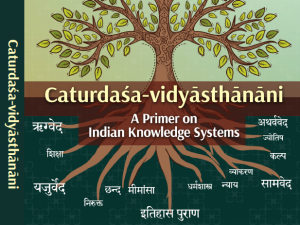
The Indian Knowledge System (IKS) is divided into several branches of knowledge, with the most well-known classification comprising 14 branches (Caturdaśa Vidyāsthānāni). These include the 4 Vedas—Rigveda, Yajurveda, Sāmaveda, and Atharvaveda—along with the 6 Vedāngas:Śikṣā (Phonetics & the science of Vedic pronunciation), Kalpa (The science of rituals), Vyākaraṇa (Linguistics and grammar), Nirukta (The science of etymology), Chandas (Prosody), and Jyotiṣa (Astronomy and astrology). Additionally, the system includes 4 Upāṅgas: Purāṇa & Itihāsa (Literature on gods and sages), Dharmasāstra (Law, ethics, and governance),Mīmāṃsā (The science of interpreting Vedic statements), Nyāyavistara (The science of logic and argumentation). This book serves as an introduction to these 14 branches of IKS, making them accessible to novices and beginners. Each branch is presented with fundamental concepts in simple language to ensure easy comprehension. To enhance engagement, the book features colorful illustrations, short stories, intriguing facts, and cross-disciplinary insights in the ‘Do You Know?’ section. Additionally, fun ‘Do It Yourself’ exercises and chapter overview concept maps provide a structured understanding of these knowledge traditions, which form the cornerstone of Indic civilisation and culture.
Upavedas, collectively referring to the applied sciences, represent the practical dimensions of the Indian Knowledge Systems (IKS). These Upavedas are also an integral part of the aṣṭādaśa-vidyāsthāna (eighteen domains of knowledge), which form the core of the Vedic knowledge corpus. They comprise highly specialised texts covering various disciplines: Life Science (Āyurveda), Warfare (Dhanurveda), Performing Arts (Gāndharvaveda), Architecture and Illustrative Arts (Sthāpatyaveda), and Statecraft and Politics (Arthaśāstra). Upaveda is an introduction to the pragmatic and functional aspects of IKS, tailored for novices and beginners. It presents fundamental concepts from each Upaveda in a clear and accessible manner to enhance understanding. Additionally, the book features vibrant illustrations, engaging short stories, intriguing facts in the ‘Do You Know?’ section, hands-on ‘Do It Yourself’ exercises, and concept maps summarising each chapter. These elements collectively offer readers a comprehensive insight into the five Upavedas that have significantly shaped the Indic civilisation and its cultural heritage.
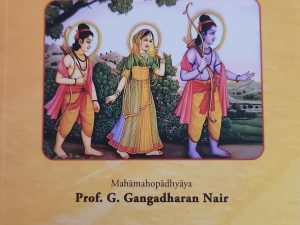
Ramayana for Universal Welfare written by MM Prof.G.Gangadharan Nairji is the selected episodes from the Ramayana . The author explained briefly the lessons we have to learn from them. It retells the Ramakatha primarily intending to transform the society through various incidents and anecdotes depicting the constant conflict between the good and evil , Dharma and Adharma. It opens the gateway to karma theory , the eternal value system, governance, alliance, and the disasters brought down by lust, infatuation and addiction on one hand, while showcasing success, prosperity and accomplishment on the other.This monograph with 30 short chapters, will certainly be an eye opener for people at large
Upaniṣads are the timeless revelations that deal with the profound knowledge of Oneness between the individual self (jīva) and the supreme Reality (Brahman). This philosophical section, also well-known as Vedānta (topical end portion of the Vedas), is considered to be the foundation of the intellectual legacy of the Sanātana Dharma. There are various opinions about the total number of Upaniṣads. However, most of them agree on 108 Upaniṣads, the list of which is given in the Muktikopaniṣad. These 108 Upaniṣads cover a variety of topics that are essential for a seeker on the spiritual path to realise the supreme Reality and attain Liberation. This book intends to provide a summary of the contents in each of the 108 Upaniṣads and can act as a ready reckoner for knowing what topics are covered under these Upaniṣads. This book is the first publication in the series of publications to follow in the ambitious 108 Upaniṣads translation project undertaken by the Chinmaya International Foundation (CIF).
The Vaiyāsika-nyāyamālā of Bhāratī-tīrtha is a good introduction to the Philosophy of Advaita as expounded by Śrī Śaṅkarācārya in Śārīraka-bhāṣya on the Brahmasūtras which were composed by Maharṣi Bādarāyaṇa culling essential spiritual principles from the Upaniṣads.
Vivekacudamani, the Crest Jewel of Viveka, the ability to discriminate, analyse and abide in the supreme Reality, is one of the masterpieces by Bhagavān Ādi Śańkarācārya. The best of his prakarana-granthas, this text is in the form of questions asked by a disciple and the answers provided by the preceptor. Viveka is to discriminate between the Real and the unreal, Eternal and non-eternal, Brahman and the world. The content is highly philosophical, that of Advaita-vedānta; yet the verses have intrinsic poetic qualities and a rhythm that make it easy to be memorised. Many figures of speech are scattered through the free- flowing mellifluous language of Śrī Ādi Śańkarācārya. This book contains each verse of Vivekacūdāmaņi (1-581) with the original Sanskrit verse, anvaya (prose-order), vṛtta, word for word meaning with grammatical analysis, and free-flowing translation.