- Description
- FAQ
- Reviews

Certificate in Hindu Spiritual Care
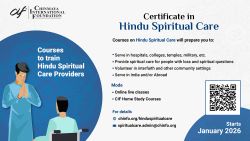
A 24-credit Certificate in Hindu Spiritual Care (CHSC) has been developed by Chinmaya International Foundation (CIF) to train Hindu Spiritual Care Providers, or Chaplains, to address the spiritual and emotional needs of individuals of Hindu faith in various secular settings, such as hospitals and hospices, schools and universities, communities, the military, corporations, or interfaith settings within India and within the global Hindu diaspora.
The primary objective of the Certificate programme is to provide a thorough training in Hindu Chaplaincy in preparation or enhancement of serving as a Chaplain or Spiritual Care Provider, in India or abroad.
On conclusion of each semester, students will receive a transcript and a “Certificate of Completion” for each course, itemizing the course content and grade received. Once all 24 credits have been completed with a passing grade, the student will receive a Certificate in Hindu Spiritual Care (CHSC).
Courses Offered
Six core courses form the major component of the Certificate, along with a spiritual retreat, totaling 24 credits. The courses will provide a strong foundation in Hinduism and Vedanta, and a practical application of the precepts and principles in the provision of Hindu spiritual care. These courses will also develop and strengthen one’s own Sadhana.
For Course Details, Schedule, and Tuition
Course Timing and Duration
The Certificate can be completed part-time within 18 months, beginning in January. The six core courses will be taught on Saturday mornings, ET (USA Eastern Time) and Wednesday or Monday evenings ET. Parts of the courses can be studied asynchronously, at the students’ convenience.
Programme Eligibility
- At least a Bachelor’s degree in any field
- A good Hindu spiritual foundation and practice and a keen interest in Hindu Spiritual Care
- A spiritual guide/mentor who can recommend and endorse them as well as continue to support them as they render spiritual care services
- A written essay describing how the applicant’s personal goals align with the vision of the programme, and how the applicant meets the prerequisites
Programme Objectives
The primary objectives of this programme are:
- to train students in Hindu Spiritual Care, otherwise called Hindu Chaplaincy
- to introduce the discipline of Spiritual Care Provision
- to introduce various concepts of philosophy and psychology ingrained in Hindu classical literature to help individuals facing distress or loss of any nature
- to provide a strong foundation in Vedanta shastras and sadhanas.
Programme Outcomes
On completion of these courses, the graduates will gain:
- Competency in Spiritual Care Provision.
- Good knowledge of the foundational principles of the Hindu religion.
- Ability to understand, observe and apply various concepts of the Spiritual Care helping relationship in diverse settings.
- These Certificate credits are accepted by the US Association of Professional Chaplains (APC) in partial completion of requirements for Board Certification of Chaplains (BCC).
- For students wishing to complete a Masters of Divinity degree (M.Div.), we recommend United Theological Seminary in Minneapolis. United offers an online M.Div. in Interreligious Chaplaincy and accepts most of the CIF graduate credits for transfer toward its degree with a Hindu Focus.
Medium of teaching:
English
Requirements:
Availability of a computer and adequate wifi to use Zoom internet/video conferencing capability with camera on is required. Having the familiarity with using computers and learning to navigate websites and learning management systems (LMS) is also required.
Start Date
January 17th
How to Apply?
Admission will be based on the applicant’s essay and recommendation letter as well as availability of seats.
Interested applicants can fill and submit the online Application Form:
Step 1: Complete the preliminary Online Application Form. Please note that there is no “save” feature, so be sure to complete the entire application before submitting.
Step 2: You will receive an email and link with more information to be filled in, and an essay to be uploaded.
Step 3: Send the ‘Recommendation Form’ to your spiritual guide/ mentor.
Step 4: We will communicate to you on your selection based on your essay and recommendation.
Step 5: If selected, we will communicate the payment information, to be paid per semester.
Selection Process
Write an essay of 500 to 750 words detailing the following:
1) Your personal history and interest in Spiritual Care
2) Significant and important persons or events that have impacted your personal growth and spiritual development
3) Statement on the need for Hindu Chaplains/Spiritual Care Providers in your community and how you wish to contribute.
Recommendation Letter
Your Spiritual Guide/ Mentor is required to complete this Recommendation Form and return it by email to spiritualcare.admin@chinfo.org. Please download the document, save it as “[Your name] Recommendation Letter,” and email it to your Spiritual Guide.
Visiting Scholars and Professors of Practice at CIF
Dr. Ramesh Pattni (DPhil Oxford, DCPsych, MSt, MSc, MA, OBE)
Dr Ramesh Pattni is a psychologist and a Hindu theologian whose research is in the intersection of these traditions. He has a deep interest in presenting the psychological concepts, tools, and techniques of the ancient traditions in today’s world for mental well-being. He obtained a doctorate from the University of Oxford, Faculty of Theology and Religion, in ‘Yoga Psychology’ based on his research into Patanjali’s text on Classical Yoga – the Yogasūtra and Western Positive Psychology, comparing the phenomenology of Flow and altered states of consciousness experienced in the meditation of Samadhi. He also has three master’s degrees in psychology, psychology of religion, and study of religion. read more…
After successfully running a family business in Kenya for 23 years, Dr. Pattni decided to go back to his passion of learning and teaching. He completed his Oxford doctorate in 2015 and has completed another doctorate in Existential counselling and psychotherapy at NSPC in London. He has lectured extensively and conducted workshops and retreats on diverse subjects over the past two decades in Yoga and the Non-Dual (Advaita Vedanta) traditions. He holds or has held many public positions, including Vice President of Chinmaya Mission UK, Vice President of Hindu Forum of Britain and Co- Chair of the Hindu Christian Forum, Trustee of Interfaith Network and continues to serve the wider community in the UK. For his voluntary work in interfaith relations and community services, such as Hindu chaplaincy, in the UK, he was bestowed an OBE (Order of the British Empire) in the New Year’s Honours 2020 by Her Majesty the Queen.
Dr. Madhu V. Sharma (PhD, MSW)
Dr. Madhu Vedak Sharma is a retired Hindu Chaplain from Duke University in Durham, North Caroline, USA, after serving the students and faculty there for nine years. She is also a volunteer Campus Hindu Minister at NC State University in Raleigh, and at the University of North Carolina at Chapel Hill, NC. She is a former President of the Triangle Interfaith Organization in Raleigh, and a former Board member of the Hindu Society of North Carolina. read more…
Dr. Sharma was born in India, raised in Africa, and has spent all her adult life in the USA. She holds a BS in Chemical Engineering, NC State University, a Masters in Social Work from the University of Iowa, and a Ph.D. in Hinduism from the Hindu University of America. She had two decades of successful engineering and management careers at two Fortune 500 companies, managed her international business, and has teaching experiences at Duke University, Indiana University, and St Ambrose University. As an Executive Coach, she has coached physicians, executives, and clergy.
Having been raised with a spiritual and religious upbringing in a priest’s family, Dr Sharma has studied Hindu scriptures and visited numerous major temples and religious sites in India during her pilgrimage. A frequent speaker at conferences, she has facilitated sessions with religious luminaries at the World Parliament of Religions in Spain and has presented at many conferences including the World Hindu Congress in New Delhi and the Annual Hindu Mandir Executives’ Conferences in Fairfax and Atlanta.
Dr. Sharma is the author of two books related to Hindu Spiritual Care, Anxiety and Vedic Wisdom, and Dharmic Advisor – A Modern Way. In her free time, she is an avid golfer.
Brahmachari Ved Chaitanya (MA Sanskrit, PhD in progress, Sandeepany Graduate)
Brahmachari Ved Chaitanya was raised in Maharashtra and completed his Bachelor of Engineering (BE) degree in Electronics and Telecommunication from Pune University. He worked in the prestigious Tata Consultancy Services (TCS) in Pune as a Software Engineer. In 2011, Br. Ved Chaitanya left his profession to pursue an inner calling to attend Chinmaya Mission’s two-year full-time residential Vedanta Seminary at Sandeepany Sadhanalaya (Mumbai). read more…
The Vedanta Seminary consists of two years of rigorous training in Vedanta (Upanisads, Bhagavad Gita, Sankara Bhashya, Prakarana Granthas), Sanskrit, Pujas, and Vedic Chanting. He studied under the guidance of Pujya Swami Tejomayananda and the tutelage of Swami Advayananda and Swami Sharadananda. After his graduation, Br. Ved Chaitanya received initiation as a Brahmachari and was posted as the Vedanta teacher at Chinmaya Mission, Navi Mumbai Centre. There he taught Vedanta and Sanskrit classes and guided the children and youth’s educational classes and elders’ Vedanta study classes.
In 2017, Br. Ved Chaitanya was posted to CIF and has been teaching Vedantic scriptures and lesson course. He earned an MA in Sanskrit studies in 2021 and is enrolled in a PhD program in Advaita Vedanta. Being a versatile orator, Br. Ved Chaitanya conducts Vedanta classes, Sanskrit instruction, and workshops for youth. He embodies all that he teaches and has rendered spiritual care to many who come to him for spiritual guidance.
Dr. Indira Palekar, Ph.D.
Dr. Indira Palekar is a licensed counseling psychologist practicing in Elyria, Ohio, since 1994. She has a private practice in psychology, working with adults, couples, and families. She also works as a psychologist for Kendal at Oberlin, a continuing care retirement community, serving residents and staff since 2007. Palekar has a Ph.D. in Counseling Psychology from The University of Akron, Ohio. Palekar has been pursuing Spiritual care/chaplaincy work for several years and has completed a 24-graduate-credit Certificate in Hindu Spiritual Care from Chinmaya International Foundation. She has also been in training in CPE (Clinical Pastoral Education) at Bob Secours Mercy Health Hospital System, Lorain /Oberlin, Ohio. read more…
Palekar attended a two-year program at One Spirit Interfaith seminary, New York, to study Interfaith and Inter-spiritual traditions, and is ordained as an Interfaith/Interspiritual Minister. She is a serious Vedanta student and is honored to serve as the Vedanta Education Coordinator and Bala Vihar Coordinator/teacher at Chinmaya Gayatri, Cleveland, Ohio. Her volunteer background is extensive. She has been volunteering as the Helpline Chair for AAIWO (Association of Asian Indian Women in Ohio) since1995, guiding women in domestic violence situations and monitoring helpline calls. She has taught Yoga at a Cancer center for over 10 years and has conducted several Yoga retreats for women. During the onset of Covid-19 lockdowns, she started leading spiritual care groups for AAIWO and for the residents of the Kendal retirement home.
Indira Palekar also volunteered as a Spiritual Health at Bon Secours Mercy Health Systems, at Mercy Allen, Oberlin, Ohio. She served as a mentor for College Now in the mid 2000’s. She has worked with Ohio Reads, Midview School system, tutoring children in elementary grades. From 2001-2019, she trained therapy dogs and made weekly visits to residents of a local nursing home with her certified therapy dogs. Palekar brings a vast array of training and experience to her Chaplaincy practice.
Dr. Richa Agarwala, Ph.D.
Dr. Richa Agarwala is presently serving as Outreach Coordinator at Chinmaya Mission Washington (DC) Regional Center (CMWRC). She has been actively involved in Community Service and Spiritual Outreach since 2015 in several capacities. Agarwala has been a student and practitioner of Advaita Vedanta with Chinmaya Mission since 2002. read more…
Agarwala has served in various positions as CMWRC’s Outreach Coordinator since March 2015. She is a member of the Leadership Team with five other ladies since June 2020 for the “All Faiths in Friendship” interfaith women’s book club, and has been a regular member of it since September 2015. She serves as the co-organizer of Montgomery County (Maryland) Faith Alliance for Climate Solutions since March 2022, and has been a member since December 2018. Agarwala is the Hindu Representative since February 2022 of Montgomery County Faith Community Advisory Group. She was the co-chair from June 2019 to October 2020 of the Faith Community Working Group Education sub-committee of Montgomery County, and a contributing member from June 2014 to October 2020. She also served as a Facilitator from 2016 to 2020 for Multicultural dialogues on Bias and Racism in Montgomery County.
Agarwala has been invited to conduct numerous presentations on Hinduism to local schools and Interfaith events. She has been a regular presenter at the “Religious literacy for educators” continuing professional development course offered by the State of Maryland and at education programs hosted by the InterFaith Council of Metropolitan Washington (IFCMW). She also helped Hindu American Foundation (HAF) pilot the Dharma Ambassador program at Chinmaya Mission centers. She brings a wealth of experience and commitment to the field of interreligious dialogue.
Community Outreach Award and Article
The prestigious “Bridge Builder Award” presented by IFCMW was awarded to Agarwala in 2019 in recognition of her interfaith work in the Washington DC metro area. She authored an article on “Book Clubs for Bridging Difficult Divides” for IFCMW in September 2023.
Profession
In her professional capacity Dr. Agarwala works as a Senior Scientist at the National Institutes of Health. She completed her graduation in Computer Science (M.S. and Ph.D.) from Iowa State University and her under-graduation in Computer Science and Engineering (B.Tech.) from Banaras Hindu University. She has published over 85 articles in peer-reviewed journals. She has also received several professional awards and scholarships.
Spiritual Care Programme Director For queries about the courses, you may email the Programme Director, Smt. Vilasini Balakrishnan, MS (Pastoral Counseling), LMHC (Retired Licensed Mental Health Counselor), at spiritualcare@chinfo.org. Vilasini Balakrishnan is a Chinmaya Mission West Board Director (USA) and graduate of Sandeepany Sadhanalaya (1978).
FAQs
To build a foundation for their chaplaincy service, the education of a Hindu Chaplain includes central Hindu teachings, relevant aspects of spiritual care literature, contributions from contemporary psychology, an exploration of the role of ritual and devotional practices, and how to serve people of different faiths, among others. The study is accompanied by a thoughtful inquiry into how these teachings are applied to a Spiritual Care Provider’s work within various settings. Practical exercises in spiritual care provision are included in the programme. The courses in Hindu Spiritual Care offered at the Chinmaya International Foundation provide a rich exposure to the practice and theory of chaplaincy in a Hindu context and prepare the students to serve in a variety of venues.